Understanding Brake Pulsations: Why Quality Rotors Aren’t Always the Problem
Why does my car shake when I step on the brakes?
Brake pulsation—felt as a vibration in the brake pedal or steering wheel—is one of the most common complaints customers bring back shortly after a brake job. In many shops, the default explanation is predictable: “Bad rotors,” “cheap parts,” or “warranty material.”
That explanation is convenient. It’s also wrong in most cases.
The uncomfortable truth is this: brake pulsation after a recent brake service is rarely caused by rotor quality. Instead, it’s almost always the result of rotor thickness variation caused by lateral runout at the hub—a condition created during installation, not manufacturing.
The Misunderstood Cause of Brake Pulsation
Modern brake rotors are manufactured to extremely tight tolerances. True “warped” rotors are rare. What drivers feel as pulsation is not warping—it’s uneven friction caused by thickness variation across the rotor face.
So where does that thickness variation come from?
It starts at the hub.
If the hub surface has rust, corrosion, debris, or existing runout—and a new rotor is simply bolted on without correction—the rotor does not sit perfectly perpendicular to the hub. That lateral runout causes the brake pads to contact the rotor unevenly. Over time (often very quickly), brake material builds up unevenly on the rotor surface.
The result:
Disc Thickness Variation (DTV)
Uneven friction transfer
Brake pulsation that appears weeks—or even days—after a brake job
At that point, the rotor gets blamed. But the damage was done at installation.
Why “New Rotors” Alone Don’t Fix the Problem
Replacing rotors without addressing hub runout is a temporary solution at best. In fact, installing new rotors on an uncorrected hub restarts the problem cycle:
Rotor is installed with existing hub runout
Pads apply uneven pressure
Friction material transfers unevenly
Thickness variation develops
Pulsation returns
This is why some vehicles seem to “eat rotors,” even when quality parts are used.
The Proper Fix: Match Machining the Rotor to the Hub
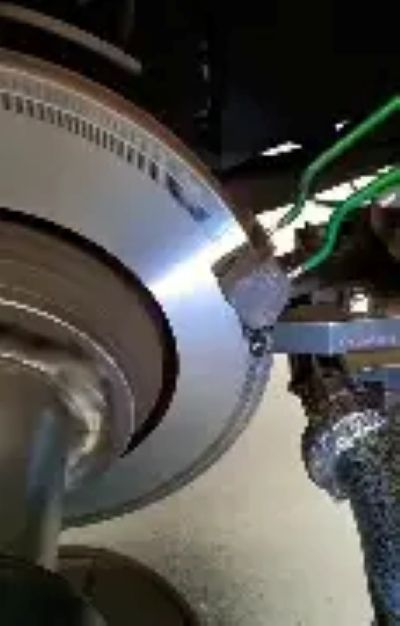
The only reliable way to eliminate lateral runout is to machine-match the rotor to the hub after installation. This process corrects the assembled runout of the hub-and-rotor combination, not just the rotor by itself.
When done correctly:
Lateral runout is eliminated
Brake material transfers evenly
Thickness variation is prevented
Pulsation is avoided long-term
This step is often skipped because it takes additional time, equipment, and understanding. But skipping it is exactly why so many “new brake jobs” fail.
How Next Gen Auto Care Performs Brake Service Correctly
At Next Gen Auto Care, we don’t just replace brake parts—we correct the root cause of brake pulsation. Every brake job follows a disciplined, repeatable process designed to eliminate installation-related failures.
1. Disassembly and Inspection
We remove the calipers, old brake pads, and caliper brackets, inspecting all components for wear, corrosion, and damage that could affect brake performance.
2. Hub Preparation and Rotor Matching
Old rotors are removed, and the hub surface is thoroughly cleaned of rust and debris. New rotors are installed and machine-matched directly to the hub, eliminating lateral runout before the vehicle ever leaves the bay.
3. Caliper Bracket Restoration
Caliper brackets are bead blasted to remove rust and scale, ensuring smooth pad movement and even clamping force.
4. Proper Lubrication
Brake grease is applied to caliper slides, pins, bushings, and all metal-to-metal contact points on the pads—critical steps often rushed or ignored.
5. Precision Reassembly
Calipers are reinstalled and torqued to manufacturer specifications. Wheels are installed and lug nuts torqued correctly to avoid inducing new runout.
6. Fluid Check, Bedding, and Verification
Brake fluid levels are checked and corrected as needed. Pads and rotors are properly bedded in, followed by a road test to confirm smooth operation and proper braking surface temperatures.
Why This Matters—for Shops and Customers Alike
Brake pulsation is not just an annoyance. It damages customer trust, increases comebacks, and leads to unnecessary warranty claims. When shops blame parts instead of process, the real problem never gets fixed.
At Next Gen Auto Care, we believe professional brake service means understanding why failures happen—and preventing them before they start.
The Bottom Line
If brake pulsation shows up shortly after a brake job, it’s probably not the rotors. It’s lateral runout that was never corrected, leading to uneven brake material buildup and thickness variation.
Quality parts matter—but correct installation matters more.
Next Gen Auto Care doesn’t guess. We measure, correct, and verify—so brakes stop smoothly, consistently, and safely.
If your vehicle is experiencing brake pulsation after recent service, or if you’re looking for a shop that does brake work the right way the first time, we’re here to help.